Why the Future Will Belong to Cognitive Infrastructure, Not Chatbots
Artificial intelligence is no longer the product.
Infrastructure is.
For the last three years, the world has been obsessed with models:
- GPT
- Claude
- Gemini
- open weights
- benchmarks
- context windows
- token pricing
That phase is ending.
The next decade will not be defined by who has the smartest model.
It will be defined by who builds the operating system underneath intelligence.
The market is already showing the transition.
The most advanced AI systems inside enterprises are quietly moving away from:
- single prompts
- isolated copilots
- chatbot interfaces
toward:
- orchestration runtimes
- distributed memory systems
- execution fabrics
- context graphs
- reasoning infrastructure
- durable cognition layers
This is not an incremental shift.
It is the architectural transition from:
- AI as software
to:
- AI as civilization-scale infrastructure.
Contents
The Chatbot Layer Is Already Commoditized
The first wave of AI adoption focused on conversation.
That made sense initially because language models are naturally conversational systems.
But enterprises discovered a brutal reality very quickly:
Conversation does not equal execution.
A chatbot can answer questions.
An institution needs:
- coordination
- governance
- memory
- accountability
- orchestration
- replayability
- lineage
- distributed execution
- recoverability
The moment AI touches:
- banking
- healthcare
- government
- defense
- insurance
- infrastructure
- industrial automation
the problem changes completely.
The question becomes:
Can the system think reliably
across time,
systems,
agents,
and failures?
That is not a chatbot problem.
That is an operating system problem.
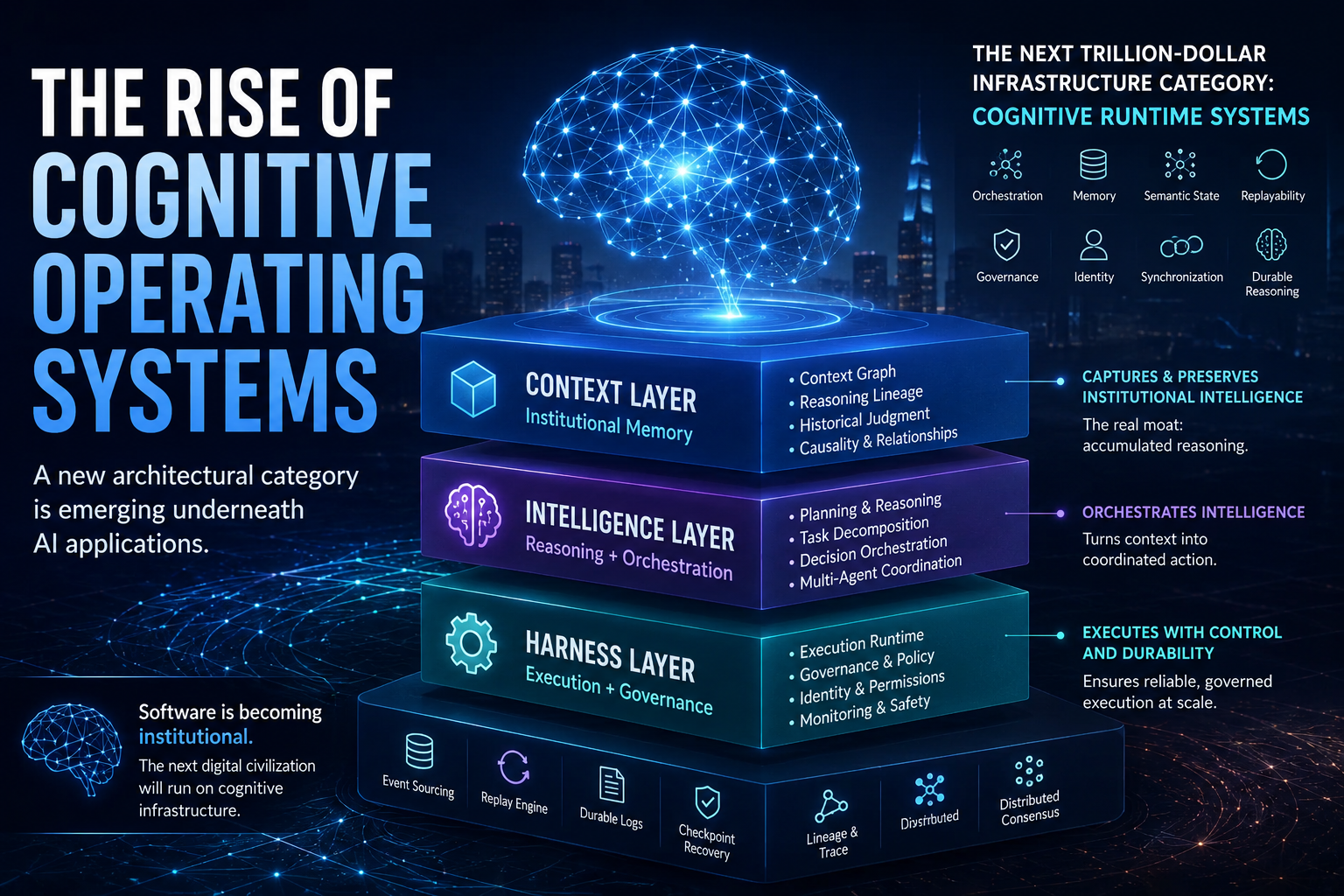
The Rise of Cognitive Operating Systems
A new architectural category is emerging underneath AI applications.
You can already see fragments of it inside:
- Anthropic agent harnesses
- OpenAI operator systems
- enterprise orchestration fabrics
- autonomous workflow runtimes
- distributed agent frameworks
- event-sourced execution engines
All of them are converging toward the same structure.
Three layers are becoming universal:
| Layer | Purpose |
|---|---|
| Context Layer | institutional memory |
| Intelligence Layer | reasoning + orchestration |
| Harness Layer | execution + governance |
Together, these form something much larger than an AI app.
They form:
- a cognitive operating system.
Context Is Becoming More Valuable Than Models
Most enterprises still believe their moat is:
- data
- models
- workflows
It is not.
The real moat is:
- accumulated institutional reasoning.
Every enterprise possesses invisible intelligence:
- exceptions
- decisions
- escalations
- operational judgment
- tribal knowledge
- execution history
Almost none of it is captured properly.
Current systems store:
- outputs
- statuses
- transactions
but not:
- why decisions happened.
This missing layer is what many researchers now call:
- the context graph.
The context graph is not a database.
It is institutional memory.
It stores:
- causality
- reasoning lineage
- execution traces
- semantic relationships
- historical judgment paths
Without this layer, every AI agent starts from zero.
With it, intelligence compounds.
That changes everything.
The Most Important Enterprise Problem Is Not Intelligence
It Is Coordination.
Large organizations do not fail because information is unavailable.
They fail because:
- reasoning fragments across systems
- context disappears during handoffs
- decisions become disconnected from their causes
This becomes catastrophic in AI-native environments.
Imagine:
- one agent approves a loan exception
- another performs risk scoring
- another handles collections
- another updates compliance systems
If reasoning is compressed into:
- SUCCESS
- FAILED
- APPROVED
then the institution loses intelligence at every transition.
This is why future enterprise systems will require:
- replay engines
- event sourcing
- durable execution journals
- checkpoint recovery
- orchestration lineage
- distributed execution history
Not for observability.
For institutional cognition.
The Next Billion-Dollar Layer Is Runtime Infrastructure
The AI market is currently over-focused on:
- wrappers
- copilots
- vertical assistants
Most of these categories will collapse into platform primitives.
The durable value will move underneath the application layer.
The next trillion-dollar infrastructure category is likely:
- cognitive runtime systems.
These systems will manage:
- orchestration
- memory
- execution graphs
- distributed agents
- semantic state
- replayability
- identity delegation
- governance enforcement
- synchronization
- durable reasoning
In the same way cloud computing required:
- Kubernetes
- container orchestration
- distributed scheduling
AI-native systems will require:
- cognition orchestration
- distributed reasoning fabrics
- institutional memory graphs
- execution durability layers
We are witnessing the birth of that stack right now.
The Future Enterprise Stack
The future enterprise architecture may look something like this:
| Layer | Future Stack |
|---|---|
| Interface | multimodal agents |
| Cognition | orchestration intelligence |
| Memory | context graph |
| Execution | distributed runtime fabric |
| Governance | policy + identity + audit |
| Persistence | event sourcing + replay |
| Infrastructure | distributed consensus systems |
This stack resembles:
- distributed databases
- operating systems
- workflow engines
- neural systems
all at once.
Because AI infrastructure is increasingly becoming:
- computational cognition infrastructure.
India Has a Rare Opportunity
India may actually possess an advantage in this transition.
Why?
Because the next phase of AI is not only about model research.
It is about:
- systems engineering
- distributed infrastructure
- orchestration
- workflow intelligence
- large-scale operational execution
India has spent two decades building:
- enterprise systems
- banking infrastructure
- large-scale IT operations
- global technology delivery
That experience maps surprisingly well into:
- AI runtime engineering
- cognitive orchestration
- institutional intelligence systems
The winners of the next era may not be the companies with the largest models.
They may be the companies that build:
- the most durable cognitive infrastructure.
The Real Shift
The biggest misconception in AI today is this:
People think AI is becoming human.

In reality,
software is becoming institutional.
That distinction matters.
The future is not:
- smarter chatbots
The future is:
- systems that accumulate reasoning
- preserve execution lineage
- coordinate autonomous workflows
- replay institutional decisions
- evolve organizational intelligence over time
That is a much bigger transition.
The companies that understand this early will not merely deploy AI.
They will build the operating systems underneath the next digital civilization.
Published for readers building the next generation of intelligence infrastructure.
Inspired by emerging architectural patterns across enterprise AI systems, distributed cognition runtimes, and institutional memory engineering.